
On a small parcel of land tucked into a Los Angeles canyon, surrounded by $20 million to $30 million Beverly Hills mansions, a piece of Southern California history lives on behind a chain-link fence. The Franklin Canyon Orange Grove is one of the last orange groves in Los Angeles, a remnant of the time when citrus sprawled out across Southern California. Last year, city officials approved plans to uproot Bothwell Ranch, the last commercial grove in the San Fernando Valley, for 21 homes, making Franklin Canyon all the more rare — especially given its high-end location.
The handful of groves that remain in Los Angeles and its surrounding suburbs are mostly too small to be used for commercial agriculture, and instead each community has been left to decide the best use for the groves that are still around.
In the Franklin Canyon Orange Grove, that’s meant carefully restoring the once-abandoned parcel of fruit trees so that the grove could be harvested again. But instead of getting shipped off to grocery stores across the nation, as Southern California’s oranges once were, the fruit picked from Franklin Canyon’s trees are distributed for free to families facing food insecurity.
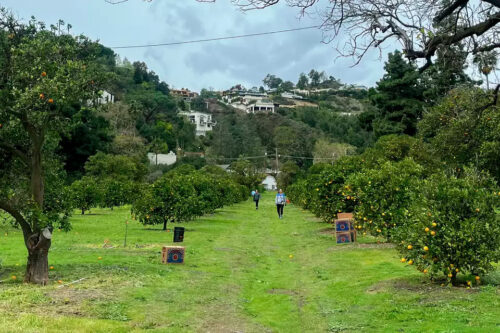
Volunteers harvest oranges at the Franklin Canyon Orange Grove on March 6, 2025. Erin Rode
For more than a decade, the Los Angeles Parks Foundation has maintained the orange grove. It partners with nonprofit Food Forward to harvest the fruit a couple times each year: first the navel variety around March, then the Valencia oranges in May or June.
For Food Forward, harvesting thousands of oranges from the small grove in Franklin Canyon is part of the organization’s mission of “urban gleaning,” or collecting excess and unused produce and redistributing it to those in need. Harvest locations can range from “one tree in someone’s backyard to commercial orchards,” said Ally Forest, senior manager of community programs at Food Forward.
The organization’s volunteers fan out across Los Angeles County and beyond, harvesting citrus, stone fruits and other produce that would otherwise go unused from backyard fruit trees and orchards. Food Forward also recovers unsold produce from local farmers markets and surplus produce from the Los Angeles Wholesale Produce Market. The collected produce is then distributed to hunger relief organizations.
On a recent overcast Thursday in Los Angeles, about two dozen volunteers spread out through the usually fenced-off orange grove to pick as many ripe navel oranges as possible. Volunteers collected 2,160 pounds of oranges, which were handed off to Project Angel Food and Feed My Poor.
The fact that the fruit was available for collection at all is something of a minor miracle, particularly in this part of Southern California. The oranges were collected under the shadow of multimillion-dollar homes, in a grove left abandoned for years before the Los Angeles Parks Foundation intervened in 2012. The 4.3-acre grove has existed on the narrow parcel of land at 1300 North Beverly Drive since at least the 1940s, according to the foundation, and was purchased by the city’s Department of Water and Power as part of the reservoir parcel.
The grove sat abandoned and fenced off for an unknown number of years, until action started the way it often does in Los Angeles — with angry neighbors. Oranges were falling off the trees and rotting on the ground, prompting calls from residents to the city.
“Somebody complained, and the LA Parks Foundation got a call about that, and that’s what got the ball moving with determining who actually managed the land and the partnership with the parks department,” said Crystal Tsoi, deputy director of the Los Angeles Parks Foundation.
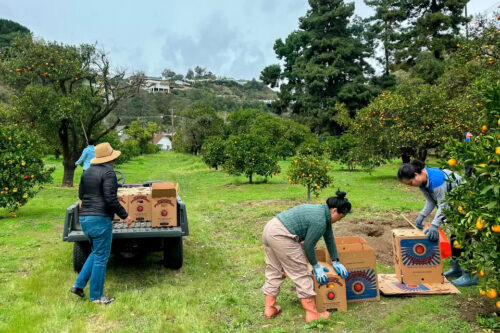
Volunteers harvest oranges at the Franklin Canyon Orange Grove on March 6, 2025. Erin Rode
Eventually the grove was leased to the city’s parks and recreation department and managed by the nonprofit foundation. Grants from the David Bohnett Foundation and City National Bank helped restore the grove, including running drip irrigation, pruning and mulching trees, removing 31 dead orange trees, plus some invasive trees, and adding new trees.
Now the orange grove lives on, just one example of how Southern California’s citrus history — a period often referred to as the state’s “second gold rush” — hides in plain sight. Leftover packing houses, once used to load citrus fruits by the case before they departed on train cars, have been transformed into trendy food halls and dining destinations. The region’s reverence for oranges also lives on in many of its place names, from the most obvious (the city and county of Orange) to the community of Valencia (named for the variety grown there before the area exploded with housing developments starting in the 1960s) to the Los Angeles County suburb of Pomona, named for the Roman goddess of fruit and fruit trees.
Even as their namesake suburbs live on, orange groves are increasingly few and far between in the region — but like Franklin Canyon, there are some attempts to keep small groves around as a reminder of this history. At Bothwell Ranch, the last commercial grove in the San Fernando Valley that is now set to become housing, about a third of the 14-acre grove will be set aside as a publicly owned orange grove used for education, according to the Los Angeles Times. In La Verne, a local history group maintains one of the last working orange groves in the San Gabriel Valley, opening it up for residents to fill bags with oranges for $8 a bag each year until they run out of fruit. And the Inland Empire city of Redlands, once considered “the heart of the largest navel orange producing region in the world,” purchased a grove in 1968 and made it part of one of the city’s biggest parks, with the grove open for residents to walk through.
In Riverside, where two of the first navel orange trees in the U.S. were planted back in 1873, the California Citrus State Historic Park pays homage to this historic past with a 248-acre grove, open to visitors and harvested by Gless Ranch, which sells the fruit.
At Franklin Canyon Orange Grove, the harvest and distribution of oranges by Food Forward represents one alternative future for the few remaining groves in Southern California, especially those that are now too small to be commercially viable — a future where oranges, once an economic powerhouse for the region, play a small role in addressing food insecurity in a region that’s increasingly unaffordable.