
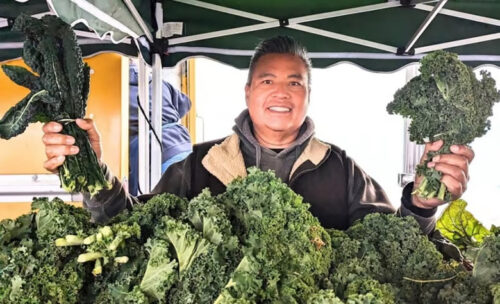
Renee Tamai of Tamai Farms is one of the new Little Tokyo Farmers Market’s vendors. Photo courtesy of Food Access LA.
Editor’s note: This article was updated on 4/1 to include more food resources and reflect changes to the hours and services provided at certain markets and food distributions.
In light of new federal eligibility changes to Cal Fresh, also known as SNAP benefits/EBT, that further exclude certain non-citizens, we’ve also put together a post with more information on the new requirements.
How can lower income Los Angeles residents access fresh, healthy, affordable food? For those living in “food deserts” that lack big grocery stores or for those hit in the latest surge of unemployment in the city, that task may be a struggle.
Though food insecurity has lessened somewhat in Los Angeles in recent years, it’s still well above the national average. And as LA Public Press has previously reported, hundreds of thousands of Angelenos could lose their food stamps in coming years after President Donald Trump and the U.S. Congress cut $187 billion through 2034 to the Supplemental Nutrition Assistance Program (SNAP) in July. At the same time, the federal government made it harder for immigrants, unhoused people, foster youth, older people and other vulnerable communities to access SNAP, according to the Center on Budget and Policy Priorities, a nonpartisan think-tank based in Washington D.C.
Matthew S. Bruns, an administrator with the LA County Department of Public Social Services, said that about 23,000 non-U.S. citizens in LA County could lose access to Calfresh (California’s SNAP-funded program), and that 9,500 citizen adults could effectively lose these benefits as well.
Monica Saucedo, senior policy fellow at the California Budget and Policy Center, said California needs to find around $2 billion each year to keep the program running at its current level because of federal cuts. The state hasn’t yet determined how it will come up with that money.
In the meantime, a variety of LA-based organizations are meeting this increasing need. Tatiana Rodgers is the founder of Miss Rodgers’ Neighborhood, which provides free food and other basic services to people in need in South LA. Miss Rodgers is confident that she and her partners will be able to adjust. She said the organization has the experience; it had to figure out how to serve people without access to food during the pandemic.
“If you pay attention to the patterns and the signs, you could see it coming, you know, like a storm far away,” she said. “Everything we’re doing now is trying to prepare for these moments … trying to be as accessible as we can and help as many people as we can, without stretching ourselves too thin.”
There are many community-led ways to access fresh food in Los Angeles and ways to volunteer to help others do so. We’ve rounded up some of them below, along with information on protocols some are taking to protect immigrants who participate in their services.
Central LA
Little Tokyo Farmers Market and Food Access LA
Calfresh EBT and SUN bucks users can access an additional monetary match on produce and other products at various farmers markets. For more information, check out Food Access LA
Location: Little Tokyo Farmers Market
Isamu Noguchi Plaza at JACCC
244 San Pedro Street
Los Angeles, CA 90012
Time: 9 a.m. to 2 p.m. Saturdays
Cost:Various costs, EBT match program available
LA’s farmers markets are a good source of fresh produce and prepared foods. Prices might be higher than in grocery stores, but participating farmers markets often match a portion of Calfresh electronic benefits transfers, or EBT, through a program called Market Match, allowing people using Calfresh to make their benefits go further.
Food Access LA runs a lot of these farmers markets, including a new one opening Saturday morning at the plaza in front of the Japanese American Cultural and Community Center (JACCC) in Little Tokyo.
Elise Dang, senior manager for farmers market operations for Northeast LA, said the new market will have around 35 vendors selling produce, hot food, packaged food and drinks, including coffee, Japanese teas and classic Japanese pastries. Three Japanese American farms will sell flowers, mushrooms and other produce. One of the vendors, Tamai farms, offers a mix of Western and Asian vegetables, including Tokyo negi green onions, kabocha squash and Japanese cucumber. The opening day program will include a taiko drumming performance and class, tai chi, a performance from musician Shin Kawasaki and art activities with the March April Studio collective.
Dang added that although there haven’t been any immigration raids at their farmers markets, Food Access LA is working with community partners to identify “private areas of business” for at-risk vendors and shoppers to go to in case of any raids. Food Access LA also developed and trained farmers market managers on how to respond to potential raids. The non-profit also runs eat!, a CSA delivery program, which people can sign up for if they don’t feel safe going to the farmers market.
There will be an EBT match program available at the Little Tokyo Farmers Market, through a grant received by JACCC, Food Access LA’s partner in opening the new market.
Food Access LA Executive Director Jennifer Grissom said there will be plenty of volunteer opportunities available at the market, especially around seasonal activities.
Volunteer opportunities for various farmers markets here. For additional information on Food Access LA’s farmers markets, go here.
Produce in the Park
This food resource is open to everyone.
Location: St. James Park
St. James Place and St. James Park W
Los Angeles, CA 90007
Time: 11:45 a.m. to 1:30 p.m. on Thursdays
Cost: Free
Mutual Aid Los Angeles Network is an information hub that connects people to mutual aid opportunities in LA County. They also run their own mutual aid projects, including Produce in the Park, which needs volunteers to help pick up grocery bags to deliver to nearby community fridges, among other tasks.
For more information visit the Mutual Aid LA Network website and Instagram account..
The ICSC Food Pantry
This food resource is open to everyone.
Location: The Islamic Center of Southern California
434 South Vermont Street
Los Angeles, CA 90020
Time: 10:30 a.m., Saturdays
Cost: Free
The Islamic Center of Southern California has an ongoing partnership with the LA Regional Food Bank and has been serving the Ktown community for 22 years! Every Saturday morning they host the ICSC food pantry. People in need of food can access essential groceries rain or shine.
More info here.
Immanuel Presbyterian Church Food Pantry
This food resource is open to everyone.
Location: Immanuel Presbyterian Church Pantry
663 S Berendo St.
Los Angeles, CA 90005.
Time: 9 a.m. to 12 p.m., Wednesdays and Fridays
Cost: Free
The Immanuel Presbyterian Church hosts a food pantry twice a week on Wednesdays and Fridays.Hot meals, shelf stable, frozen goods, and fresh produce are available for patrons. The church also has diaper and menstrual programs on Tuesday. You can get more information here.
More info here.
South LA
Crop Swap LA
The farmstand discounts are open to EBT users only.
Location: Crop Swap LA farmstand
3753 Degnan Boulevard
Los Angeles, CA 90018
Time: 11 a.m. to 2 p.m., Sundays
Cost: Various costs, EBT discount available.
Crop Swap LA is an urban farming non-profit based in LA’s West Adams area. The organization runs a farmstand every Sunday at their microfarm on Degnan Boulevard. Customers who use EBT get 50% off.
Crop Swap also offers a produce membership program. For $80 a month, the organization provides hyperlocally grown organic produce every week to people living within a mile of their farms. Crop Swap accepts EBT as a form of payment for this membership and prioritizes people in vulnerable communities. The organization also urban farming workshops and wellness events and is soliciting volunteers within 5 miles of Leimert Park to harvest surplus fruit.
More info here.
Alma Backyard Farms
This food resource is open to everyone
Location: Compton Farm Stand and Brunch
801 E. Redondo Beach Boulevard
Compton, CA 90220
Time: 8 a.m. to noon every first and third Sunday of the month
Cost: Various costs.
Alma Backyard Farms grows food at its Compton and San Pedro urban farms and distributes food at its farmstands multiple times a month. It operates on a pay-what-you-can model. Alma Backyard food also sells prepared food at its Compton farmstand, such as paella in mid-August.
Miss Rodgers’ Neighborhood
West Athens Community Fridge
Location:
1010 West 108th Street
Los Angeles, CA 90044
Time: 9:30 a.m. to 5 p.m.
Cost: Free
Watts Community Fridge
Location: Watts Labor Community Action Committee
10950 S. Central Avenue, Los Angeles, CA 90059
Time: 24/7
Cost: Free
Family First Saturday and People’s Free Food Drive are currently on pause.LA’s community fridgesare still operational and open to everyone
Miss Rodgers’ Neighborhood has been providing free food and other essential services to people at regular distribution events and community fridges in the South LA area for 10 years. The organization’s Family First Saturday events offer hot food, groceries, laundry supplies, immigration assistance and other services. People can also sign up for a physician check-up with St. John’s Community Health clinic, which occurs from noon until around 2:30 to 3 p.m. About twice a month, the organization runs the People’s Free Food Drive, filling people’s cars with one to two weeks worth of groceries.
Miss Rodgers’ said that her goal is to be consistent with these events, so that people can set their calendars by them. She organized Family First Saturday with the reality in mind that a lot of people have paid their rent, and so their savings may be depleted. They can pick up food and other supplies and make it to the next paycheck.
“Ultimately the goal is self-actualization and people becoming the best versions of themselves,” she said. “But they can’t do that if they’re still stressing about how to put food on the table.”
Miss Rodgers there is a plan to protect people in the event of an immigration raid but declined to give further details due to safety concerns.
Miss Rodgers’ Neighborhood welcomes new volunteers who are able to help meet that need, as well as resource donations. Below is more information about how to access Miss Rodgers’ Neighborhoods food drives and get involved.
Northeast LA
El Sereno Community Care Wednesdays
This food resource is open to everyone
Location: El Sereno Community Garden
5466 Huntington Dr S
Los Angeles, CA 90032
Time: 9 a.m. to 11 a.m., Wednesdays
Cost: Free
El Sereno’s Community Care Wednesday is a food distribution operating every Wednesday at the El Sereno Community Garden. Participants can receive free fruit, vegetables, eggs, milk, and more. The food distribution is organized by the El Sereno GreenGrocer.
More info here.
San Fernando Valley
Really Really Free Market
This food resource is open to everyone
Location: 6270 Van Nuys Boulevard
Time:1 p.m. to 5 p.m. on Saturday, April 11th
Cost: Free
Aetna Street Solidarity operates the Really Really Free Market in the San Fernando Valley, with free food, clothing, household goods and more. The next market is being held on Sunday, April 11 from 1 to 5 pm at 6270 Van Nuys Boulevard. Follow Aetna Street Solidarity on Instagram for updates.
South Bay
Alma Backyard Farms
This food resource is open to everyone
Location: San Pedro Farm Stand
1265 W. Sepulveda Street
San Pedro, CA 90732
Time: 8 a.m. to noon every second Sunday of the month
Cost: Free
Alma Backyard Farms grows food at its Compton and San Pedro urban farms and distributes food at its farmstands multiple times a month. It operates on a pay-what-you-can model. Alma Backyard food also sells prepared food at its Compton farmstand, such as paella in mid-August.
More info here.
Multiple Locations
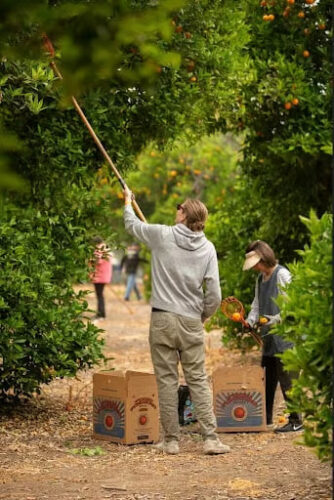
Food Forward workers and volunteers picking oranges during Zest Fest, a group harvest event that took place on June 7, 2025 at the California State University Northridge orange grove. (Photo by Caroline Chou.)
Food Forward
This food resource is open to everyone
A non-profit organization based out of Southern California for the last 15 years, Food Forward rescues surplus produce from a variety of sources and redistributes it to communities experiencing food insecurity through more than 250 hunger relief partners. The majority of the food redistributed goes to partners based in LA County.
Food Forward rescues and redistributes produce through three programs. In its backyard harvest program, Food Forward workers harvest surplus fruits and vegetables from private backyards and estates. The farmers market recovery program involves collecting excess produce from farmers markets. And the wholesale recovery program involves rescuing excess produce from warehouses to donate directly to hunger relief partners.
Nkemdilim Nwosu, communications director for Food Forward, said the organization works to make communities healthier by providing them with fresh produce at no cost. “ Produce isn’t cheap,” she said. “It also doesn’t last long, so it’s probably not usually the first priority in food-insecure communities. It’s about getting them that access without the worry of having to pay for it.”
In 2024, Food Forward rescued around 94 million pounds or around $185 million worth of produce, according to its annual report. The organization worked with a little more than 2,000 volunteers last year and welcomes more.
People interested in volunteering with Food Forward’s farmers market recovery program and its backyard harvest program can find more information here. Food forward is also looking for more partners for its wholesale rescue program, although there is a waitlist due to high demand. A form to donate to the wholesale recovery program is here.
Food Forward also offers a DIY Backyard Harvest program. Volunteers can register their own backyard trees and the organization provides equipment for them to harvest any excess produce and drop it off directly with one of the organization’s partners. More information here.
Operation Healthy Hearts
This food resource is open to everyone
For more resources, the mutual aid organization Operation Healthy Hearts has compiled a master list of food banks, mutual aid distributions and EBT resources in LA County. Access the list here.