
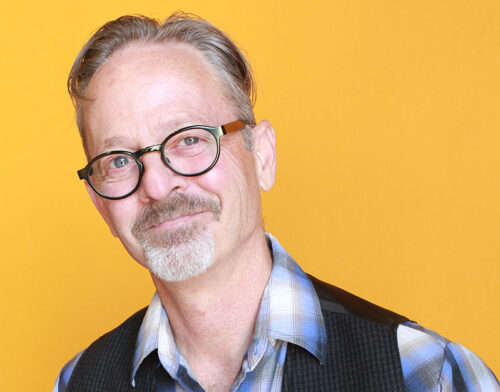
Rick Nahmias
Food Forward recovers surplus produce that would go to waste and distributes it to agencies who feed the hungry.
“We’re the Robin Hoods of produce,” Rick Nahmias, founder and CEO of Food Forward, told the Journal. “We recover it, we refrigerate it and then we redistribute it free of charge to [the] last count was about 260 agencies,”
Food Forward focuses specifically on healthy, fresh produce. Nutrition equity is a big part of their mission. The nonprofit is based in Los Angeles, but their work reaches the entire Southwest.
“There’s about 400 varieties of produce that flow through the organization, and they could go as far as tribal lands in Southwestern US, if the surplus allows, they reach farm workers, children, immigrants, low income elderly folks, the LGBT community,” he said.
Nahmias is very proud of the diversity of groups they’re able to help.
“Depending on which statistic you read, either one in four or one in five families in California or Los Angeles are food insecure, which is crazy when you consider the affluence of this region,” he said. “With the fires, as well, there’s an entirely new ecosystem of people who worked in service restaurants, domestic help, gardeners, who now have no jobs and who are going to find themselves in need of food assistance.”
Food Forward began in 2009. Nahmias often walked his dog around his neighborhood in the Valley Glen area of the San Fernando Valley.
“As my dog got older and the walks got slower, I started to notice all this fruit on trees that was going to waste, especially this time of year, which is citrus season,” he said. There was an abundance of grapefruits, lemons, oranges and tangerines.
“Maybe a few went to someone’s office or the family that had the tree, but for the most part, it was going to squirrels, rats and under car wheels,” he said.
He remembers thinking, “If you just got some volunteers and harvested this fruit, and then got it over to an agency that could deliver it to people, that’s an amazing bridge of supply and demand. Why don’t we try this?”
So he did. Nahmias worked with SOVA for the first few harvests.
“They took the produce and said, ‘Great, when’s the next delivery?’” Nahmias said.
The initiative grew from there. By the end of that first year they rescued and distributed 100,000 pounds of hand picked produce. By the second year, they rescued 250,000 pounds.
“Today, we move over 250,000 pounds on a slow day,” he said. “We’ve scaled now to 90 to 100 million pounds a year.”
In addition to their larger initiatives, Food Forward has two volunteer-powered programs. They still do backyard harvesting, where they train volunteers on site, who then go out for a two-hour harvesting experience. It’s citrus, apples or pomegranates, depending on the season.
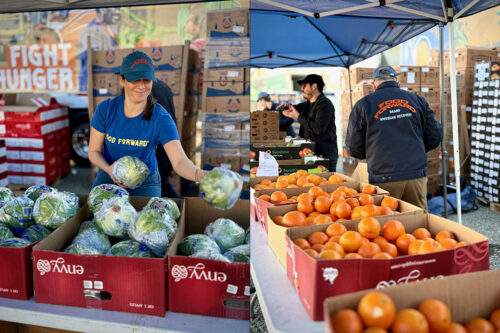
They also have a farmer’s market recovery program at about 16 markets in Los Angeles and Ventura counties. People can volunteer at a single session or train to be a team leader. Volunteers distribute boxes to the local small farmers. At the end of the market, they will box up the surplus produce to donate; local agencies will pick up and use as they see fit.
What started by rescuing food from local fruit trees has turned into a bounty of abundance. The ultimate win-win-win situation. Nahmias said they enumerated it once and discovered there are about 40 wins within the Food Forward movement.
“We’re seeing folks who are food insecure, across this huge panorama, eating healthy produce they would not get otherwise,” he said. “The other wins are volunteers are getting a sense of how they contribute to this virtuous cycle; we’re seeing agencies, who would otherwise have to buy this produce, get it for free; we’re seeing a lack of waste going into the ozone. … I can go on and on.”
A trained cook, Nahmias attended the Culinary Institute of America in his late 20s early 30s.
“I would not call myself a chef, but … I know my way around a kitchen,” he said. One of his favorite recipes, his grandmother’s stuffed cabbage, is below.
Nahmias’ work with Food Forward followed a career as a documentary photographer. He spent about two years documenting the human cost of feeding the country by following the stories of migrant farm workers.
“When you saw the conditions and you saw the lives and the dedication and the challenges that migrant farm workers face, it put a whole new value on what food is,” he said. “My work as a chef and the food waste elements [added] another layer of appreciation.”
Nahmias feels that sharing abundance was and remains the heartbeat of Food Forward.
“I don’t talk about a glass half-full or a glass half-empty,” Nahmias said. “When I talk about Food Forward, I come at it from a glass overflowing: How do we share that? How do we give it away? Food should be gifted.”
Learn more at foodfoward.org.
Read Ryan Torek’s cover story on Food Forward.
For the full conversation, listen to the podcast: