
Local food distributors have proven to be a vital resource across Los Angeles this year as access to free and low-cost food has become increasingly limited for many residents.
Following January’s wildfires, many families found themselves needing immediate access to food. As ICE raids ramped up across Los Angeles this summer, some residents began sheltering in place, in many cases losing income. Rising inflation has pushed up grocery prices, and CalFresh took a serious hit during the government shutdown when federal food assistance program benefits were cut back.
Across the city, nonprofits like Food Forward have been stepping up to help.
“People are really, really struggling right now in Los Angeles to get those basic needs,” said Food Forward Communications Director Nkemdilim Nwosu.
Food Forward collects fruit and vegetables from volunteer gardens and partner organizations around L.A., which they then package and redistribute. The majority of the food comes from the Los Angeles Wholesale Produce Market’s wholesale recovery program.
One of their distribution partners is the Social Justice Learning Institute (SJLI), which hands out free 15-pound bags of fresh produce weekly at their Inglewood drop-in center. Produce arrives every Friday and is unloaded and packed by a small team for later distribution.
Food Forward provides 90% of the produce for SJLI and the other 10% is grown on-site in Inglewood. “We grow enough that we are able to give them fresh greens in these bags, along with what Food Forward gives us,” said SJLI Health Equity Programs Director Nicole Steele.
She said SJLI’s partnership with Food Forward has been transformative for clients in South Central and Inglewood, who often don’t have access to green spaces, clean air or fresh fruit and vegetables.
“Being able to serve them en masse with enough fruits and vegetables to maybe last them over the weekend and make a full meal, we can serve people consistently,” said Steele. “They know they can come to us to get these resources — and not only that, it builds community.”
A quarter of all Angelenos were already struggling to get enough food before this year’s particular challenges began, according to a 2024 study from USC Dornsife. Black (31%) and Latine (32%) individuals were particularly at risk, being three times more likely to experience food insecurity compared to white residents (11%). Only 14% of Asian residents reported their experiences with food insecurity.
2025 was a particularly hard year for people already at risk of not getting enough to eat and troubles started only a week after the new year began.
Food after fire
When the Eaton and Palisades fires devastated parts of L.A. in January, residents of those communities needed food fast.
Food Forward volunteers showed up to help, packaging and distributing much-needed produce to local food initiatives. The nonprofit partnered with 13 organizations, including the National Day Laborer Organizing Network, Bienestar in Pasadena and Support + Feed in Bell Gardens to provide emergency fresh produce to affected communities.
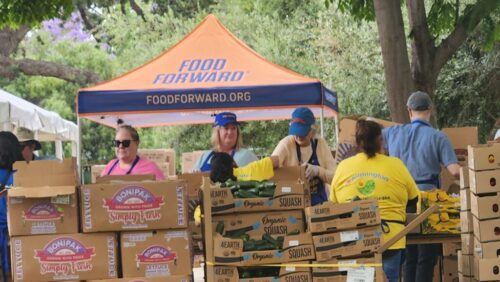
Volunteers pack produce during Zest Fest 2025. (Eliza Partika/AfroLA)
Bienestar added a drive-thru distribution in Pasadena serving 200 families daily, for which Food Forward provided 100% of produce donations throughout the summer months.
Food Forward also assisted Comunidades Indígenas en Liderazgo, an Indigenous, women-led organization in South L.A., with emergency food distribution to service workers impacted by the fires.
In June, the nonprofit held ZestFest to assist with fire recovery and feed families in need. More than 150 volunteers harvested around 3,000 pounds of oranges from the Cal State Northridge orchard, and packed about 7,000 pounds of mixed produce including pineapples, pears, peppers, lettuce, celery, carrots, potatoes, squash and apples.
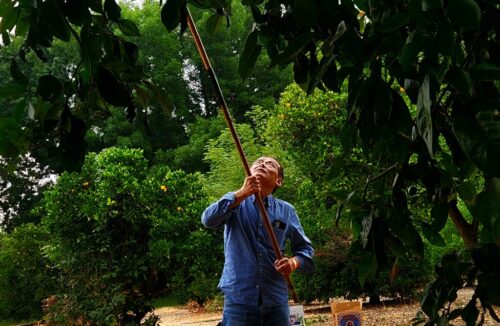
A Food Forward volunteer picks oranges from Cal State Northridge’s citrus grove at ZestFest. (Eliza Partika/AfroLA)
In 2024, Food Forward distributed 94 million pounds of produce. By January of this year, the organization saw a 40% increase in food distribution. In the first months of 2025, their food distribution increased by around 22%, compared to the same time last year.
In July, the nonprofit reached its goal of 500 million pounds of produce harvested and distributed to families in need.
“Our focus was those who were in the areas [affected by the Eaton Fire] as well as those working in the Palisades. It’s not only the people who live there who lost their livelihoods, but the people that worked there — the housekeepers, groundskeepers, cooks,” said Nwosu.
Local and federal upheaval
This summer, ICE raids pushed many Angelenos away from public spaces, and residents who were afraid of going out still needed to access food. People came together once again to establish grassroots food networks to feed their friends, neighbors and community members.
It’s this kind of community focus — people getting out and getting to know their neighbors — that can help everyone work together in times of crisis, said Natalie Flores-Blackner, founder of Nourish LA / Nuestros Alimentos, a local nonprofit that hosts weekly food distributions.
“[Everyone has] stories; they have gifts,” she said. “I think that’s really the key to helping create [a] bridge in all this, is really just opening up your door. Make a little bit of extra food. Make some cookies and bring them outside.”
Every Sunday, Nourish LA hands out about 20,000 pounds of food to the community. They were founded during the COVID-19 pandemic and are no strangers to crisis situations, said Flores, but things are getting worse.
“We have learned how to adapt and really lean on our community. It’s just gotten crazier. The cost of food is insane. [People are] looking for resources. They’re trying to figure out how they are going to stretch their dollars so their kids can still go to soccer or get tutoring,” she said.
When the announcement came that cuts were coming to federal food asssistance funding, food distributors and the people who relied on them braced for harder times.
On Oct. 1, the U.S. government initiated a federal shutdown, causing federally funded programs to come to a halt. USDA Food and Nutrition Services (FNS) released a memo to state agencies on Oct. 10 informing them of a shortage of funding to cover November 2025 SNAP — or food stamp — benefits.
One of the programs that was going to be affected was CalFresh, which covers approximately 5.5 million Californians and is 100% federally funded, according to a memo released by the California Department of Social Services (CDSS) on Oct. 20.
The California Food Assistance Program (CFAP), which is a statewide program designed to provide CalFresh-style benefits to certain immigrant populations, was also affected.
With the holidays approaching, Angelenos turned once again to the help they could find locally.
“With the cost of food, and people in hiding needing food, and [with food stamps] getting cut short, that’s only going to increase the need for sure,” said Flores-Blackner. “It just shows how important our services are — and community in general.”
Lines at food banks grew and local nonprofits braced themselves to do more of the work they’ve been doing for years.
Building a lasting impact
Alongside managing current crises, organizations across L.A. for years have been looking for ways to build resiliency and a lasting impact at the community level.
Nourish LA has outgrown its current space and hopes to be able to expand its services in 2026, said Flores-Blackner. One idea is to potentially begin hosting a regular distribution day especially for seniors, or people who have trouble standing for long periods of time, or who have mobility assistance needs.
They are also looking into creating educational nodules they can share with other cities or organizations who would like to build their own food distribution networks.
Nourish LA also plans to conduct a survey of the people in their food distribution lines, to better understand what the need is. “We have people who have told us that they come all the way from Koreatown and the Valley. So we want to figure out where people are coming from. That would help us have the ability to [know] we need to create a food distribution here, or partner with a local church,” said Flores-Blackner.
By meeting people where they are, nonprofits like these have a better ability to serve diverse communities’ individual needs and wants.
“We know through research that when people have to tighten their belts, the first thing to go is vegetables,” said SJLI’s Steele. “Most of the communities that we serve culturally, fruits and vegetables are part of their cuisine. They’re a part of the ways that they cook, and it allows folks to feel pride in how they parent right and how they’re taking care of their friends and family.”
That’s one of the reasons Steele and her team focus on more than just food distribution. In 2014, SJLI succeeded in passing local legislation known as the Neighborhood Food Act, which allowed renters to grow food in their apartment complexes. The group also sponsors more than 100 school, community and home gardens throughout South L.A.
What began with a farmers market at Morningside High School has expanded to include an urban agriculture initiative, food distribution and hot meals. Now, SJLI distributes to local school districts and clinics, as well as city and county parks throughout Los Angeles.
“It has been really awesome for folks to say, ‘You know, I’m so happy that I can come here because I wasn’t going to be able to have fruits and vegetables for my kids this week.’ Or, like, ‘Oh my gosh, my daughter loves grapes, but they’re so expensive; I just can’t buy them,’” Steele said.
A healthy focus on education
Food education is an integral part of creating sustainable solutions for food insecurity. Food Forward’s Nwosu said their mission is to not only provide great nutrition, but to educate families on how to build healthy communities.
Grace Hyun, a longtime volunteer with Food Forward, began helping out six years ago because of the joy she said it brought her to reduce food waste and distribute essentials, along with educating people about the importance of eating fresh fruit and vegetables.
“Even on a small scale, there’s so much to learn about,” she said.
Estelle Saucedo, a 50-year Inglewood resident who used SJLI’s food distribution services in 2020, said she began both cooking for her neighbors and referring them to SJLI when she saw how much the nonprofit was helping.
Now retired, Saucedo is the “grandmother” of the community. She provides translations for community members who only speak Spanish to ensure everyone gets the food they need. Saucedo also often brings empanadas and other hot meals to SJLI’s Friday distributions. A recent favorite, said Steele, was Saucedo’s homemade coconut tarts.
“It feels good and empowering to help people in the neighborhood,” Saucedo said.
Community members who want to help out can donate produce to one of the 260 hunger relief organizations that partner with Food Forward, SJLI or Nourish LA. They can also share fruit and vegetables directly from home gardens or trees, or from private or commercial orchards, or cook a meal for a neighbor in need.
Steele said the community is empowering each other by sharing education about food and policy, and keeping each other involved.
“What we’re able to do with that is a dignified way for us to serve each other in our communities and create equity,” she said. “We are happy here. We are joyful here. We’re sharing information and knowledge here.”